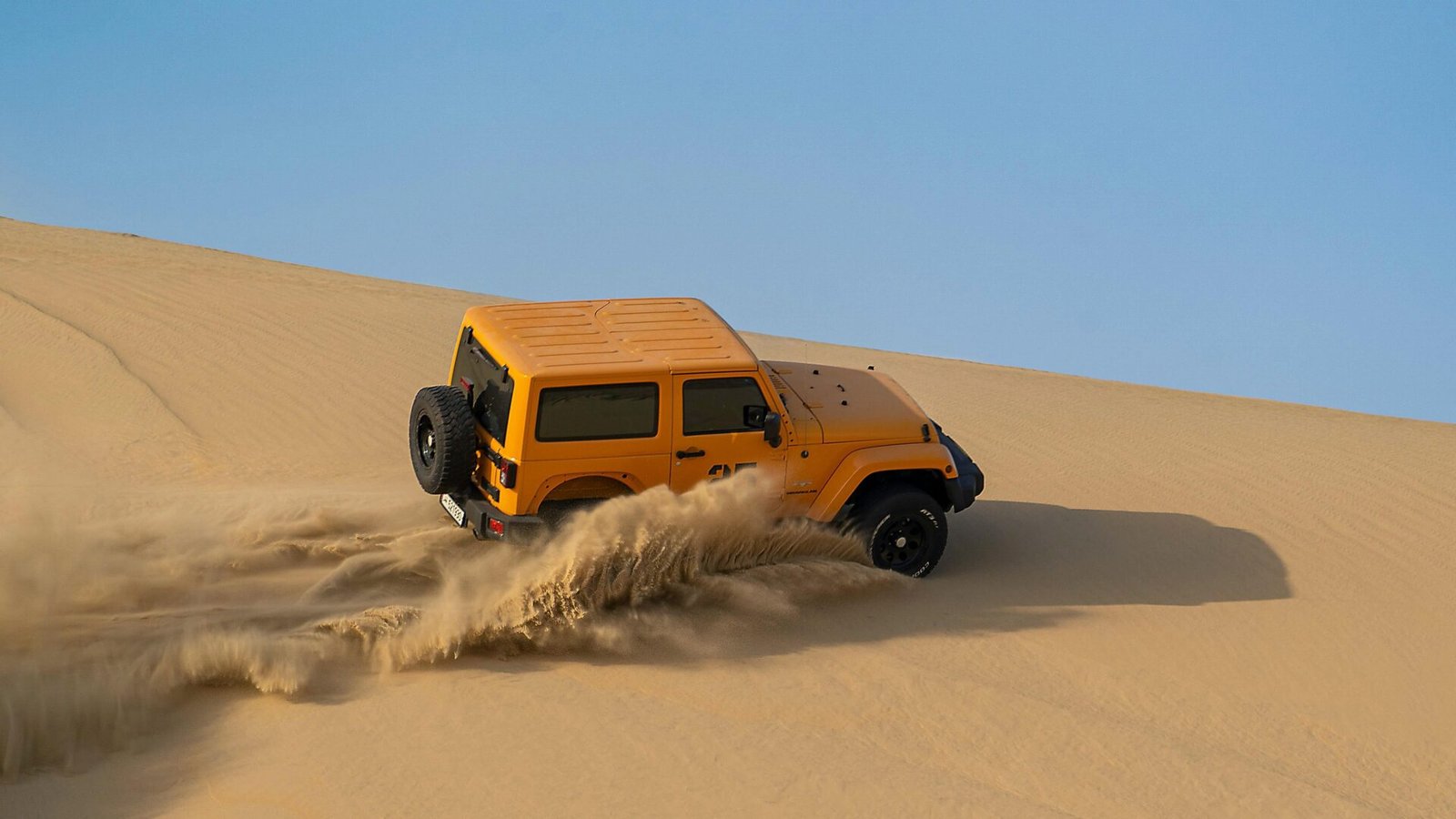
A 4WD sends power to all four wheels but usually has no low range gearing. A true 4×4 has low range, which lets you crawl through deep sand and steep terrain without destroying the gearbox. In Namibia, a standard 4WD SUV handles the main tarred roads and most gravel perfectly fine. But destinations like Sossusvlei, Damaraland, the Skeleton Coast, and the Kaokoveld will stop a standard SUV completely. The wrong vehicle choice is the single most expensive mistake tourists make in this country. A recovery from soft sand costs EUR 150 (USD $165) to EUR 300 (USD $330). An itinerary that matches your vehicle to your actual route costs €100 (USD $110 / R2,000).
| Feature | 4WD SUV | True 4×4 |
|---|---|---|
| Low range gearing | No | Yes |
| Deep sand | Will get stuck | Handles it |
| Tar and main gravel | Perfect | Perfect |
| Fuel economy | Better | Worse |
| Rental cost per day | Lower | Higher |
| Examples | RAV4, Tucson, Fortuner (without low range) | Land Cruiser, Hilux, Fortuner (with low range) |
When planning a Namibia road trip the first real decision you face is 4×4 vs 4WD Namibia and which one your route actually needs. It is not just a question of budget. It is the difference between a great holiday and paying thousands of rand to be pulled out of the sand in the middle of nowhere. This guide gives you the honest answer before you land.
The vehicle answer depends entirely on where you are going, so the route has to come first. Johan settles both on a free call, and a booking agency Mantis works with can book the vehicle to match.
4×4 vs 4WD: What Is the Actual Difference?
Most people use these two terms as if they mean the same thing. They do not. A 4WD vehicle like a standard Toyota RAV4 or a Hyundai Tucson sends power to all four wheels. On a light gravel road or a tarmac highway it is perfectly fine. The problem is that most 4WD SUVs do not have low range gearing.
Low range is what allows a vehicle to crawl slowly through deep sand, steep inclines, or heavily corrugated gravel without destroying the gearbox or getting stuck. Think of it like bicycle gears. High gear is great for flat road. But if you try to pedal up a steep hill in high gear, you stall. Low range is the low gear that gives you the torque to push through tough terrain at walking speed without the engine screaming.
A true 4×4 like a Toyota Land Cruiser or a Toyota Hilux with low range gives you that capability. It is built to handle terrain that would stop a standard SUV completely. In Namibia that distinction matters enormously depending on where you are going.
Where a Standard 4WD SUV Is Perfectly Fine
Not every trip in Namibia requires a serious off-road vehicle. If your route keeps you on the main roads a 4WD SUV is more than enough and will save you money on the rental and on fuel every single day. Here is exactly where a standard SUV handles the job.
| Route | Road Type |
|---|---|
| Windhoek to Swakopmund (B2) | Fully tarred, well maintained |
| Windhoek to Etosha (B1 and B8) | Mostly tarmac, manageable gravel inside park |
| Etosha internal roads | Graded gravel, slow speed fine in a SUV |
| Sossusvlei up to the 2×4 parking area | Tarred road, fine for any vehicle |
| Fish River Canyon viewpoints | Gravel but well graded, SUV fine |
| Spitzkoppe access road | Short gravel, manageable |
| Most lodge access roads | Short gravel tracks, well maintained |
If your trip looks like this you do not need to pay extra for a heavy duty 4×4 in Namibia. A comfortable SUV will save you money and be easier to drive. The key is knowing your route before you choose your vehicle. For a full picture of what each road letter means (B, C, D, F) and what vehicle it needs, the Namibia road types guide breaks it all down.
Where You Absolutely Need a True 4×4
This is where people get caught out. Some destinations in Namibia will stop a 4WD SUV completely and the recovery cost is not cheap.
Sossusvlei and DeadVlei
This is the most common mistake tourists make in the entire country. The road from the 2×4 parking area to DeadVlei is about 5km of deep soft sand. A 4WD SUV without low range will sink into that sand and stop moving. You will then have to wait for a recovery vehicle and that bill can run into several thousand rand.
To reach DeadVlei in your own vehicle you need a true 4×4 with low range gearing and reduced tyre pressure. If you do not have that vehicle the park operates a shuttle service from the 2×4 parking area for around N$200 (USD $11 / €10) per person. The shuttle is not a cop out. Experienced travellers and even some rental companies recommend it because the sand conditions change daily. In early 2026 the park temporarily made the shuttle mandatory because too many self-drivers were getting stuck and blocking the track.
There is also a timing advantage most people do not know about. Guests staying inside the park at camps like Sesriem Campsite are allowed through the gate one hour before guests staying outside the park. If you stay outside and arrive at the gate at opening time you will find a queue that can stretch for kilometres. By the time that queue moves and you reach the dunes the best morning light is already gone. Where you sleep the night before Sossusvlei changes the entire experience.
Damaraland and the Kunene Region
The remote northwest of Namibia involves serious gravel and rocky tracks. The roads to Twyfelfontein Rock Art, the Petrified Forest, the Organ Pipes, and the desert-adapted elephants around Palmwag are rough, unpredictable, and long. A 4WD SUV on these tracks risks damaged suspension, blown tyres, and being stranded far from the nearest town with no cell signal. These areas are where Namibia feels truly wild and they need a vehicle to match.
The Skeleton Coast
The C34 salt road from Swakopmund heading north can become dangerously slippery when the coastal mist rolls in. Heavy mists create reflections and mirages on the road surface. A 4×4 gives you better traction and stability. The further north you go, the worse the road gets and the more remote you are.
Kaokoveld (Northwest Namibia)
This region is only accessible by 4×4. If you want to see the Himba communities, the rugged mountain passes, or drive anything near Van Zyl’s Pass, you need a properly equipped vehicle with recovery gear, a second spare tyre, and experience. This is not a first-timer destination.
The Caprivi Strip (Zambezi Region)
The Kaudom area and eastern conservancies involve sandy tracks and potential river crossings. In the wet season (November to April) mud becomes a serious factor. A 4×4 is not optional here.
Wet Season Travel Anywhere
Rain changes everything in Namibia. A C road that is fast and firm in dry season can become deeply corrugated or partially washed out after heavy rain. A D road can become completely impassable. If you are travelling between November and April, a 4×4 is recommended even on routes that would be fine in a SUV during the dry season. The self-drive tips guide covers wet season driving in more detail.
Which Rental Vehicle Should You Actually Choose?
Rental companies in Namibia typically offer three categories and most people do not understand the differences until they are already on the road.
Select a category to see what it handles and what it does not.
Automatic or Manual?
If you can drive manual, rent manual. Automatic vehicles are more expensive to hire, less common in Namibia (so less availability and less choice), and give you less control on gravel. On loose surfaces, using gears to slow down is a key technique that automatics do not offer in the same way. If you can only drive automatic that is fine, just know you will pay more and have fewer options when booking.
The Suzuki Jimny Question
The Jimny is popular with European tourists because it is small, capable off-road, and less intimidating than a full-size Hilux. It handles sand and rocky terrain surprisingly well for its size. But it has real limitations for longer Namibia trips. The fuel tank only holds 40 litres, which becomes a problem in remote areas where fuel stops are 200km or more apart. The maximum payload is 325kg (including passengers, fuel, and gear), so it runs out of capacity fast. It is extremely susceptible to crosswinds especially with a loaded roof rack. And the short wheelbase makes long corrugated gravel roads genuinely uncomfortable over hours of driving. For a short trip staying near the main routes, the Jimny works. For a 10 to 14 day circuit covering serious distance, a Hilux or Fortuner is a better choice.
Tyre Pressure: The Factor Nobody Tells You About
Most rental companies hand you a vehicle and send you on your way. They do not always tell you that tyre pressure is one of the most important factors in the 4×4 vs 4WD Namibia decision.
On soft sand you need to drop your tyre pressure significantly. This increases the surface area of the tyre touching the ground, which is what stops you from sinking. Think of it like snowshoes versus boots. The bigger the footprint, the less you sink. If you drive onto a sandy track at the same tyre pressure you use on the highway you are going to get stuck regardless of how capable your vehicle is.
A general starting point is to drop from your highway pressure (around 2.2 to 2.4 bar) down to about 1.4 to 1.6 bar for sand. Some experienced drivers go as low as 1.2 bar in very soft conditions. But the correct number varies by vehicle weight, tyre size, and the specific sand you are on. After driving the sand section, you need to reinflate before driving on gravel or tar at speed. There is an Engen fuel station right outside the Sossusvlei park gate where most people reinflate.
Sand Driving: The Basics You Need Before Sossusvlei
If you have never driven on sand before, here is what you need to know. It is not complicated but it is different from anything you have done on tar or gravel.
First, engage 4×4 low range (4L) before you hit the sand. Do not wait until you are already stuck. Second, keep your speed steady. You want enough momentum to carry you through soft patches but not so much speed that you lose control. Think walking pace to jogging pace. Third, follow existing tracks where possible. The sand is more compacted where other vehicles have driven. Fourth, do not stop in deep sand unless you absolutely have to. Starting again from a standstill in soft sand is where most people get stuck. If you need to stop, try to find a firmer patch or an uphill section where gravity helps you get moving again. Fifth, if you feel the vehicle slowing and sinking, do not accelerate harder. Spinning the wheels just digs you deeper. Ease off, keep the wheels straight, and let the vehicle find its own traction.
Insurance: What You Need to Know Before You Sign
This is the section most people skip when booking and the section most people wish they had read when something goes wrong on the road.
Standard rental insurance in Namibia typically does not cover undercarriage damage. It often does not cover windscreen damage. It sometimes does not cover tyre damage. And some basic policies exclude gravel roads entirely, which is a problem since you will be on gravel within an hour of leaving Windhoek in most directions.
Before you sign anything, confirm whether your policy covers gravel and dirt road driving (not just tarred roads), single vehicle rollovers on gravel, windscreen damage from flying stones, tyre punctures and sidewall damage, and undercarriage damage from rocks or corrugation. If the answer to any of those is no, you are carrying the risk yourself and gravel road incidents are common, not rare.
Most rental companies fit all vehicles with a speed tracking device. If you exceed the gravel speed limit (80 km/h) and have an incident, your insurance is voided. This is not a technicality. It is enforced. The road types guide explains exactly what speed is safe on each surface.
What Should Be in Your Rental Vehicle
A properly equipped rental 4×4 for Namibia should come with the following. If any of these are missing when you collect the vehicle, ask before you leave the yard.
| Item | Why It Matters |
|---|---|
| Two spare wheels | One spare leaves you exposed. Punctures on gravel are common enough that a second spare is the right answer. |
| Hi-lift jack + wooden blocks | A standard jack sinks into sand or soft ground. Wooden blocks give it a stable base. |
| Shovel | For digging out of sand. You will not need it often, but when you do, nothing else works. |
| Tow strap or recovery strap | For pulling out or being pulled out. A passing vehicle with a tow strap solves most stuck situations in minutes. |
| Traction boards | Place under the wheels for grip in sand. Not always included but worth requesting. |
| Tyre pressure gauge | Mechanical, not digital. For checking and adjusting pressure before and after sand sections. |
| Air compressor | For reinflating tyres after sand driving if you are far from a fuel station. |
| Tyre repair kit (plugs) | A temporary fix that gets you to the nearest town for a proper repair. |
When you collect the vehicle, the handover should take at least an hour. If the rental company rushes you through in 15 minutes, that tells you something about how seriously they take preparation. A proper handover covers how the 4×4 system works (when to engage 4H vs 4L), how to change a tyre with the specific jack provided, how the fridge and camping gear work if included, and a walk-through of every piece of recovery equipment. If they are not showing you this, ask.
The Real Cost of Getting the Vehicle Decision Wrong
People try to save money by renting a cheaper 4WD SUV instead of a true 4×4. That logic backfires quickly when the route demands more than the vehicle can deliver.
| What Goes Wrong | Typical Cost |
|---|---|
| Recovery from soft sand at Sossusvlei | EUR 150 to EUR 300 |
| Tyre blowout on corrugated gravel (per tyre) | EUR 75 to EUR 150 |
| Suspension damage on rocky D-road | EUR 250+ |
| Windscreen replacement from gravel chips | EUR 100 to EUR 200 |
| Undercarriage damage (often not insured) | EUR 150 to EUR 400 |
The smarter move is to match the vehicle to the route from the start. Sometimes that means a true 4×4. Sometimes a standard SUV is genuinely fine. The key is knowing which applies to your specific itinerary before you drive into the desert.
What to Ask Your Rental Company Before You Book
The answers to these questions will tell you a lot about whether the operation takes preparation seriously or whether they are just handing you keys and hoping for the best.
Ask how many spare wheels are included. Ask what recovery gear comes standard. Ask whether the insurance covers gravel roads, tyres, windscreen, and undercarriage. Ask what happens if something goes wrong at night or over a weekend. Ask whether there is 24-hour roadside support and what that actually means in practice (some companies define it as “we will coordinate a tow truck to your location” which can take 12 hours in remote areas). Ask whether the vehicle has a speed tracking device and what the consequences are if you exceed the gravel limit.
If the company cannot answer these questions clearly, that is your answer.
Want the Vehicle Decision Made for You?
The 4×4 vs 4WD Namibia question is just one part of planning a trip here properly. Your vehicle choice depends on your specific route, the time of year, whether you are camping or staying in lodges, and how many people and how much gear you are carrying. Getting that one decision right saves you from overpaying for a vehicle you do not need or underpaying for one that cannot handle where you are going.
Johan van Eeden has been driving and planning routes through Namibia for over 25 years. A custom itinerary gives you a route with the exact vehicle recommendation for your roads, realistic driving times, a tyre pressure guide for your specific vehicle and terrain, accommodation suggestions, a provisions map, and gate timing strategy for parks like Sossusvlei. It costs €100 (USD $110 / R2,000), after a free first call. Most people spend more than that recovering from a single wrong call in the desert.
For park bookings and access information, visit Namibia Wildlife Resorts directly. For more on planning your trip, start with the complete self-drive tips guide or check the budget guide if cost is a factor in your vehicle decision.
For park bookings and access information, visit Namibia Wildlife Resorts directly.