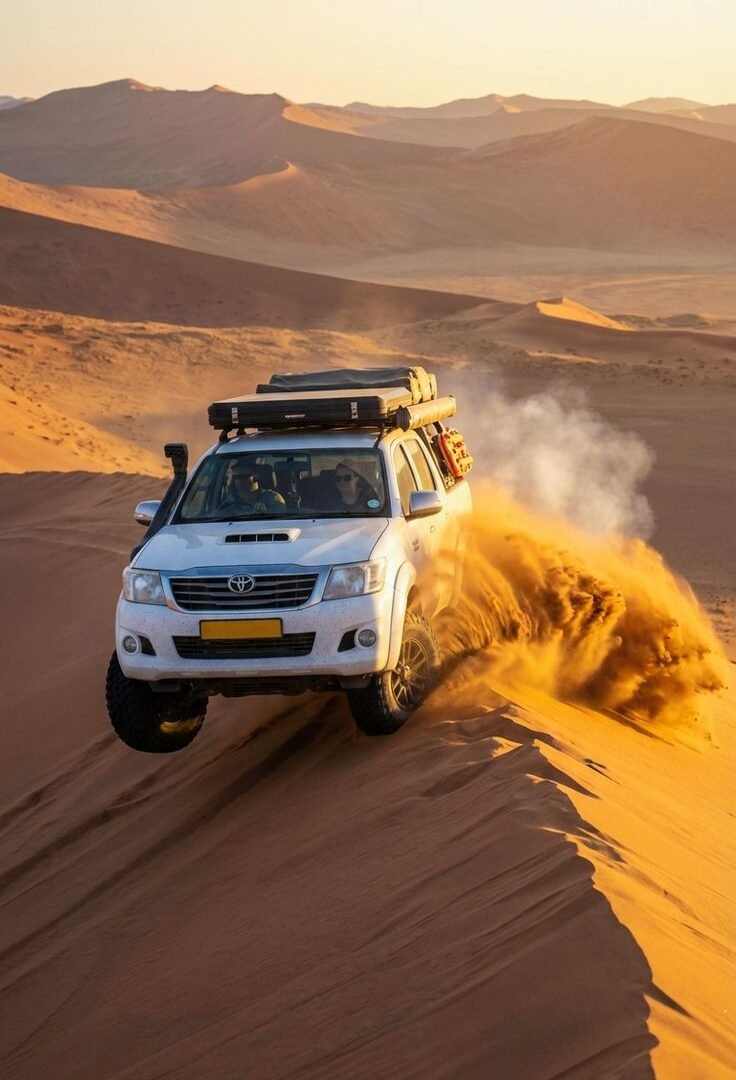
A Namibia self drive trip takes 12 to 14 days to cover the main highlights. Budget around N$6,300 (USD $350) for a 12 day SUV rental and N$4,500 (USD $250) for fuel, plus roughly N$1,100 a night for accommodation. Most of the route is gravel, so add at least 50 percent to every Google Maps driving time.
A Namibia self drive trip is one of the best road trips on the planet. Travellers who have been to 80 or 90 countries keep saying Namibia is the one that surprised them the most. But here is the thing that nobody tells you until you are already on the road and it is too late to fix it. Google Maps will tell you a drive takes four hours. On Namibian gravel that same drive takes seven. You will arrive at your lodge after dark on a road with no streetlights and no fences keeping animals off the tarmac. That is genuinely dangerous. And it happens to people every single week because they planned their Namibia self drive trip the same way they would plan a road trip through Europe.
Namibia is closer to an expedition than a holiday drive. The country is almost the size of France and Germany combined but has a population of only about 2.5 million people. Outside the main towns there is nothing for hundreds of kilometres. No fuel stations. No shops. No cell signal. Very few other cars. If you do not plan for this you will waste entire days sitting in queues, backtracking from wrong turns, or stuck in sand 200 kilometres from the nearest town with absolutely no way to call for help.
This guide covers every part of planning a Namibia self drive trip using real costs from actual travellers, honest vehicle advice, a proven 12 day route you can follow day by day, and the insider strategies that experienced Namibia travellers rely on every time they go back. All of it comes from people who have actually done this trip and from someone who has been driving Namibian roads for over 25 years.
That 50 percent rule is the most useful thing on this page, and it is easier to apply to a route somebody has already driven. Johan builds the route around real driving times, starting with a free call.
What a Namibia Self Drive Trip Costs in 2026
Before anything else, here are the actual numbers. Not estimates from a brochure. These are real figures from travellers who completed this trip.
| Expense | Estimated Cost (Per Person) |
|---|---|
| Car rental (12 days, basic SUV from Windhoek) | N$6,300 (USD $350 / €320) |
| Fuel (full 12 day route covering main highlights) | N$4,500 (USD $250 / €230) |
| Accommodation (budget to mid range per night) | N$1,100 (USD $61 / €56) per night |
| Etosha National Park entry (per person per day) | N$180 (USD $10 / €9) + N$54 (USD $3 / €2.70) vehicle fee |
| Sossusvlei entry (per person per day) | N$108 (USD $6 / €5.50) + N$18 (USD $1 / €0.90) vehicle fee |
| Sossusvlei shuttle to Deadvlei (if no 4×4) | N$200 (USD $11 / €10) per person |
| Full 23 day trip from Europe (flights, car, stays, activities) | N$65,700 (USD $3,650 / €3,350) |
National park fees in Namibia are very reasonable compared to East African parks. Etosha charges about N$180 (USD $10 / €9) per person per day. Sossusvlei is even cheaper at N$108 (USD $6 / €5.50). These are some of the most affordable national park fees anywhere in Southern Africa for the quality of wildlife and scenery you get.
Food is where you save the most money. Most lodges and farm stays have a kitchen or a braai area. A braai is the Southern African version of a barbecue where you cook meat over an open wood fire. If you buy groceries at a supermarket and cook for yourself your daily food costs drop dramatically. Stock up on meat at a good butchery in one of the larger towns before heading into remote areas. Local bars and roadside food counters serve solid hot meals for a few dollars. For a full line by line breakdown of every cost category including fuel, food, accommodation, and park fees, that guide has the complete picture.
The total cost depends mostly on three decisions. How many days you go. Whether you camp or stay in lodges. And whether you cook for yourself or eat out. But even on a tight budget, Namibia is very doable without cutting corners on the actual experience. The trick is knowing where to spend and where to save, and the biggest savings come from getting the vehicle choice right.
Do You Actually Need a 4×4 for a Namibia Self Drive Trip?
This is the most common question and the most commonly answered wrong. The honest answer depends entirely on your route.
For the main tourist corridor between Windhoek, Etosha National Park, Swakopmund, and Sossusvlei you do not need a 4×4. These roads are a mix of well maintained tar and graded gravel. A standard SUV or even a larger sedan handles them fine. Something like a Toyota RAV4 or a similar crossover is more than enough for the vast majority of the main routes. These vehicles are cheaper to rent and they burn less fuel, which adds up fast over a 12 to 14 day trip.
Where you absolutely need a proper high clearance 4×4 with low range gearing is on specific terrain. The deep sand approach to Deadvlei inside the Sossusvlei area is the most common example. If you try to drive it in a normal SUV you will get stuck. The recovery vehicle will cost you N$7,200 (USD $400 / €370) or more. Other areas that require a true 4×4 include parts of the Kaokoveld, Damaraland, and the four digit numbered roads (called D roads) that go deep into the bush.
The mistake most people make is booking the cheapest rental car without checking what roads are actually on their route. Gravel and deep sand are very different things. A car that handles gravel fine can sink completely in loose sand and leave you stranded with no cell signal and no other vehicles for hours. The full breakdown of 4×4 vs 4WD and which vehicle matches which Namibian roads explains exactly how to make this call.
The smart approach is to decide your route first and then pick the vehicle that matches it. Not the other way around. If you are not sure which vehicle fits your specific route, book a planning session with Johan and he will match the right vehicle to every road on your itinerary so you never overpay for capability you do not need or underpay and get stuck somewhere you should not be.
But the vehicle only matters if you understand what the roads are actually like. And Namibian roads are nothing like what most international travellers expect.
Namibian Roads: What Nobody Warns You About
Namibia has a road classification system that uses letters and numbers. Once you understand it the whole country makes sense. If you do not understand it you will underestimate every single drive on your trip.
B roads are the main tar highways. They are well maintained, generally smooth, and you can drive at the speed limit comfortably. The B1 from Windhoek to the south and the B2 from Windhoek to the coast are the big ones. These are easy driving and feel similar to highways in most countries.
C roads are the major gravel roads. They connect the main towns and tourist areas. Most C roads are graded regularly and in reasonable condition during the dry season. You can usually drive 80 to 100 kilometres per hour on a well graded C road. But after rain or between grading cycles they develop corrugations (a washboard pattern) that shakes the vehicle and slows you down to 60 or 70 kilometres per hour. This is the road surface that makes Google Maps driving times completely wrong for Namibia.
D roads are the smaller district roads. These are where Namibia gets interesting. D roads range from decent gravel tracks to rocky paths through farmland that require careful driving. Some are beautiful and quiet. Some will test your vehicle and your patience. The four digit D roads in particular can be very rough and are where you are most likely to be completely alone on the road for hours.
Salt roads are a unique Namibian thing. These roads are made from compacted salt and they are excellent to drive on when dry. Smooth, fast, almost like tar. But when wet they become incredibly slippery. The stretch from Swakopmund south along the coast uses salt roads and they can catch people off guard after a coastal fog. For the full explanation of every road type in Namibia and what each one demands from your vehicle and your planning, read that guide before you set your route.
The single most important rule for driving in Namibia is this. Add at least 50 percent to whatever Google Maps tells you. On some stretches double it. A drive that Google says takes 4 hours will take 6 to 7 hours on corrugated gravel. If you plan your days based on Google Maps times you will be driving in the dark. In Namibia, driving after dark means no streetlights, no road markings, and animals wandering across the road. Kudu, springbok, oryx, even elephants in the north. Hitting a kudu at speed will destroy your vehicle and could kill you. Never plan to arrive anywhere after sunset.
Understanding the roads is half the battle. The other half is making sure you can actually get fuel on them.
How Do You Handle Fuel on a Namibia Self Drive Trip?
Fill up every time you see a petrol station, even if your tank is half full. The distances between fuel stops are longer than most travellers expect, and some remote stations run dry without warning. It is the easiest rule on this page to follow and the most expensive one to ignore.
| Route leg | Distance | Fuel available | Advice |
|---|---|---|---|
| Windhoek to Rehoboth | ~90km | Yes | Top up here before heading south toward Sossusvlei |
| Sesriem (Sossusvlei gate area) | ~330km from Windhoek | Limited | Available but expensive. Fill in Rehoboth or Solitaire first. |
| Solitaire to Swakopmund | ~280km | Solitaire only | Fill at Solitaire. Nothing else on this stretch until the coast. |
| Outjo to Etosha (Anderson Gate) | ~110km | Yes in Outjo | Outjo is the last proper fuel stop. Fill up before entering the park. |
| Kaokoland / Kunene (remote) | Up to 400km between stops | Unreliable | Carry a minimum 20L spare canister. This is not optional. |
Fuel is what decides where you can realistically stop each night. That is what shapes the route.
Which Route Should a Namibia Self Drive Follow?
There are two ways most people drive Namibia, and which one fits depends on where you start.
Flying into Windhoek. The classic loop runs Windhoek, Sesriem and Sossusvlei, Swakopmund, Spitzkoppe, Damaraland and Etosha, then back to Windhoek. It is laid out day by day, with distances and driving times, in the Namibia self drive itinerary.
Driving up from South Africa. Cross at Ariamsvlei and spend the first night in Keetmanshoop, where the Quiver Tree Forest and Giant’s Playground are close by. Head up to Windhoek to stock up, then north through Outjo, the last big supply stop, into Etosha. Okaukuejo’s floodlit waterhole is where rhino come to drink at night, and Halali makes a good second base. Leave through the eastern gate to resupply in Tsumeb or Otjiwarongo, drive west to Swakopmund, then south to Sesriem for Sossusvlei and Deadvlei. The quiet town of Maltahohe, surrounded by guest farms, breaks the drive back towards the border.
If you have 14 days instead of 12 add an extra day in Swakopmund to do a boat cruise in Walvis Bay where you can see seals, dolphins, and flamingos. You could also add a hot air balloon ride over the desert. Travellers consistently say it is one of the best experiences of the entire trip. For the detailed version of this route with alternative stops, driving distances for each day, and options for 10, 12, or 14 day versions, the complete day by day Namibia self drive itinerary has everything mapped out.
If you are flying in from Europe or the United States rather than driving from South Africa, your trip starts and ends in Windhoek. That changes the first and last days of this route but the core loop stays the same. And if you are coming overland from Cape Town, the Cape Town to Namibia road trip guide covers every border crossing and fuel stop on the way up.
The route is one thing. But where you eat and resupply along the way is just as important, because once you leave the main towns the shelves get empty fast.
Where to Buy Food and Supplies on a Namibia Self Drive Trip
This catches almost everyone off guard. Namibia is not a country where you can just pull over and find a shop whenever you need something. Once you leave the main towns there might not be another proper grocery store for 300 or 400 kilometres. If you do not stock up at the right places you will run out of food, drinking water, or braai wood in the middle of nowhere.
The key supply towns are Windhoek, Swakopmund, Tsumeb, Outjo, Otjiwarongo, and Keetmanshoop. These have proper supermarkets like Spar, Pick n Pay, or Shoprite where you can buy everything you need. Smaller towns along the main routes will have basic shops but the selection is limited and the prices are higher.
If you are planning to braai (and you should, it is one of the best parts of the trip), buy your wood and charcoal in one of the bigger towns because you will not find it easily once you head into the remote stretches. Buy your meat at a local butchery rather than a supermarket. The quality is better and the prices are lower. Namibian beef and game meat are excellent and a proper braai under the stars in the Namibian bush is an experience you will not forget.
The complete town by town guide showing exactly where to buy food in Namibia along the main self drive routes covers which towns have the best butcheries, where to find drinking water, and the last reliable supply stops before the big remote stretches. And if you are crossing the border from South Africa and wondering what food you can actually bring with you, that is a separate set of rules you need to know about before you pack the car.
For a breakdown of how much food actually costs on the road and what a realistic daily food budget looks like, the Namibia road trip food budget guide has real numbers from real trips.
Keeping your vehicle fuelled and your cooler box stocked is the logistics side. The safety side is just as straightforward, but the risks are not what most people expect.
Is a Namibia Self Drive Trip Safe?
Yes. Namibia is consistently rated as one of the safest countries in Africa for tourists. The crime rate is low. The population density is the second lowest in the world which means you barely see anyone on most roads outside of towns. Almost everyone speaks English. Solo women have completed four week self drive camping trips without feeling unsafe. Families with young children do this trip regularly. If safety concerns are holding you back, the full safety guide covers crime statistics, health risks, and what to actually watch out for.
The real dangers on a Namibia self drive trip have nothing to do with crime. They are about the environment and the distances involved.
Cell phone signal disappears completely on many stretches of road. If your car breaks down or you get a flat tyre on a quiet gravel road you may wait an hour or more before another vehicle passes. On the main tourist routes between Etosha, Swakopmund, and Sossusvlei there is enough traffic that help will eventually come. But on the more remote routes you should travel with at least two vehicles.
There are a few non negotiable safety rules that experienced Namibia travellers follow every single time. Fill your fuel tank at every petrol station you see, even if it is still half full. Do not assume the next town has fuel. Carry at least 10 litres of drinking water per person in the vehicle. Let someone know your planned route for each day. And the most important one of all. Never drive after sunset on gravel roads. There are no streetlights. There are no road markings. And there are animals on the road that you will not see until it is too late.
If you are thinking about doing this trip solo, it is absolutely possible and many people do. The solo travel guide covers the specific considerations for driving Namibia on your own.
Safety is manageable with the right preparation. But timing your trip to the right season makes a bigger difference than most people realise.
Best Time to Go on a Namibia Self Drive Trip
May to September is the best window. This is the dry season in Namibia which means the gravel roads are in their best condition. The temperatures are cooler, which matters when you are spending six or seven hours in a vehicle crossing the desert. In Etosha National Park the dry season is the best time for wildlife because animals gather at the waterholes to drink. You can sit quietly and watch elephants, zebras, giraffes, springbok, oryx, and if you are lucky, lions and leopards come to you one after another.
October and November are transition months. It starts getting hot but the rains have not arrived so the roads are still mostly fine. This is also when you see baby animals in the parks.
December to March is the summer rainy season. The heat regularly exceeds 40°C (104°F) in the interior. Rain can turn gravel roads into muddy tracks that are difficult and sometimes impossible to drive. If you travel in summer, stick to tar roads and plan shorter driving days. The upside is the landscape turns green and the birdlife is spectacular.
For the full month by month breakdown showing exactly what weather, wildlife, and road conditions to expect throughout the year, the best time to visit Namibia guide covers it all.
Activities to Book Before You Arrive
A self drive trip gives you freedom on the road, but a few of the best experiences in Namibia cannot be added on the day. Build them into the route when you book the beds, not once you are already there.
- Walvis Bay boat cruises. Morning trips out to the seals and dolphins. In peak season they fill up, so reserve before you reach Swakopmund.
- Sandwich Harbour. The dunes drop straight into the sea about 60 km south of Walvis Bay. The drive runs along the beach in a 4×4 at low tide only, and independent visitors need a permit, so almost everyone goes with a guided tour.
- Etosha night drives. Guided night drives from the rest camps show you a different park after dark. Reserve them when you book the camp.
- Balloon flights over the Sossusvlei dunes. They leave before sunrise and are booked in advance.
Leave them out of the first plan and you either miss them or squeeze them into the wrong day and throw the rest of the route off.
Whenever you go, there is one stop on the route that needs its own strategy. And getting this right is the difference between the best morning of your trip and sitting in a queue watching the sunrise light disappear.
The Sossusvlei Gate Strategy That Changes Everything
Sossusvlei is the number one highlight on most Namibia self drive trips. The towering red sand dunes. The white clay pan of Deadvlei with its ancient dead trees silhouetted against orange sand. The sunrise light turning the dunes from pink to deep red to blazing orange. It is one of the most photographed landscapes in the world. But the logistics of actually getting there catch a lot of first timers off guard.
The Sesriem Gate is the only entrance to the Sossusvlei area. It opens at sunrise for people staying outside the gate and one hour before sunrise for people staying inside the gate at the NWR campsites or Sossus Dune Lodge. That one hour makes a massive difference. If you are outside the gate you will sit in a queue with dozens of other vehicles. By the time you drive the 65 kilometres from the gate to the parking area the golden light is already fading.
If you stay inside the gate you drive in while it is still dark, arrive at the dunes before anyone else, and get the sunrise to yourself. This is the single most important booking decision on your entire trip. Book inside the gate as far in advance as you can. Those spots fill up months ahead during peak season. For official park accommodation bookings, Namibia Wildlife Resorts (NWR) handles all reservations inside national parks. For a wider look at where to stay across the entire country, the full accommodation guide covers lodges, campsites, and guest farms along the main routes.
There is also the last 5 kilometres from the main parking area to Deadvlei. This stretch is deep soft sand. You absolutely need a proper 4×4 with low range gearing to drive it. If you try it in a normal SUV you will get stuck and pay for a recovery. There is a shuttle that costs N$200 (USD $11 / €10) per person that runs from the parking area. If you do not have a 4×4 the shuttle is your only option and it works well. The Windhoek to Sossusvlei route guide covers the full drive including fuel stops, road conditions, and the gate timing in detail.
The gate strategy is the kind of insider knowledge that separates a good trip from a great one. But there are a few other things that people only learn after the fact, and most of them are easy to fix if you know about them in advance.
What People Wish They Knew Before Their Namibia Self Drive Trip
Google Maps will get your driving times wrong. It shows you the distance but does not account for road surface, speed on gravel, gate closing times, or the fact that the last fuel stop was 300 kilometres ago. A four hour drive on tar in Europe is completely different from a four hour drive on corrugated Namibian gravel. Always add 50 percent to whatever Google Maps tells you. In some cases double it.
Book Etosha and Sossusvlei accommodation as early as possible. These places fill up months ahead during the dry season from May to September. If you arrive without a booking your only option might be the most expensive lodge available. Or nothing at all.
Tyre pressure matters more than you think. On gravel roads most rental companies recommend lowering to around 1.8 to 2.0 bar to improve grip and reduce the risk of a blowout. On deep sand like the road to Deadvlei you may need to drop even lower. Make sure you know how to check and adjust tyre pressure before you leave. Always carry a working pump and a spare tyre.
Download offline maps before you leave cell coverage. There are stretches where you will have no signal for an entire day. A paper map of the country is cheap and it could save your trip if your phone dies or loses signal.
The D roads are where Namibia gets really special. These back roads take you through private farms, remote valleys, and landscapes you will have completely to yourself. They are rougher than the main routes but the payoff is incredible. The travellers who love Namibia the most are the ones who slow down and explore these quieter corners rather than rushing between the big name highlights.
You need a visa. If you are flying in from Europe, the UK, or the United States, Namibia offers a visa on arrival at the airport for most nationalities. The fee is N$1,600 (about USD $89 / €82) per adult. Have your documents ready before you land so you are not scrambling at the immigration counter after a long flight.
Knowing what to expect is half the battle. The other half is not making the mistakes that ruin the trip before it really starts.
Common Mistakes That Ruin a Namibia Self Drive Trip
Booking the cheapest rental car without checking if it handles your route. A sedan might save you money upfront but if it cannot handle gravel you will destroy the suspension and end up paying far more in damage fees than you saved. Some rental companies will void your insurance entirely if you take a 2WD vehicle onto certain gravel roads. Read the fine print before you sign.
Trying to see everything in 10 days. Namibia is enormous. The distances between attractions are much longer than they look on a map. Trying to rush through it means you spend most of your holiday behind a steering wheel instead of actually enjoying the places you came to see. A good 12 day trip covers the main highlights comfortably. A 14 day trip gives you breathing room. Anything under 10 days means you are cutting something important.
Not filling up the fuel tank at every petrol station. There are stretches where the next fuel stop is 300 or 400 kilometres away. Running out of fuel on a remote gravel road with no cell signal is not a small problem. It is an emergency. Make it a habit. Every time you see a fuel station, fill up. Even if your tank is half full.
Staying outside the Sesriem Gate at Sossusvlei. If you do not book inside the gate you will miss the best light and spend your morning in a queue instead of on the dunes. This is the number one regret travellers mention after their trip.
Not budgeting for food between towns. If you plan to cook your own meals (and most travellers do to save money) you need to stock up at the right towns. Once you leave the main supply points there is nothing for a very long time. The food supply guide shows you exactly where to stop and what to buy.
Avoiding these mistakes makes the trip better. But having the right gear in the car is what makes it comfortable.
What to Pack for a Namibia Self Drive Trip
Namibia is a desert environment and you need to pack accordingly. The items that actually make or break your trip are the practical ones that most people forget.
Water. Carry at least 10 litres of drinking water per person in the vehicle at all times. This is not optional. If you break down in the desert without water you are in serious trouble.
Tyre gear. A tyre pressure gauge and a portable air compressor. These are essential on gravel roads where you will be adjusting pressure regularly. Make sure your rental vehicle has a spare tyre and that you know how to change it.
First aid and medication. A basic first aid kit and any prescription medication you need for the full trip. Pharmacies are rare outside major towns.
Lighting. A headlamp or torch. Many campsites have no lighting at night and you will need your hands free for cooking, setting up camp, and navigating.
Warm layers. Desert nights can drop below 5°C (41°F) even in winter. If you are camping, bring proper warm clothing for the evenings and early mornings.
Sunscreen. Bring far more than you think you need. The Namibian sun is intense even on cloudy days and you will be outside for long stretches.
For the complete packing list with everything you need for a camping trip of two to three weeks, the Namibia camping gear guide covers every item.
Why Travellers Use a Custom Itinerary Instead of Figuring It Out Alone
You can absolutely plan a Namibia self drive trip yourself. Thousands of people do it every year using blogs, forums, and Google Maps. But the travellers who get the best experience are almost always the ones who had someone with local knowledge help them build their route.
A planning session with someone who has driven every road in Namibia over 25 years gives you information that is not available on Google or travel forums. Things like which specific roads are safe for your specific vehicle right now, not last year. Which lodges and campsites are worth the money and which ones are overpriced. Where to buy the best meat and supplies along your route. The exact timing strategy for Sossusvlei so you get the sunrise without the queue. Which activities are worth doing at each stop and which ones are tourist traps. How to adjust your tyre pressure for different road surfaces. And how to build a pace into your trip that lets you actually relax and enjoy the places you are visiting instead of rushing between them.
Johan has formal qualifications as a Certified Nature Guide, a Qualified Lodge and Hospitality Manager, and holds a Dangerous Game Approach Certification. This is not someone who visited Namibia once and wrote a blog post about it. This is someone who knows these roads the way a local knows the streets of their own town.
The itinerary costs approximately €100 (USD $110). The average traveller who plans without local knowledge ends up spending far more than that on wrong vehicle choices, missed bookings, wasted fuel from wrong routes, and recovery fees from getting stuck. The itinerary pays for itself before you even start driving.
After the itinerary, a booking agency Mantis works with can handle all the bookings for a separate fee. Accommodation, vehicle rental, activities, park permits. Everything. You get the route from Johan and then the agency does all the admin so you do not have to chase 15 different booking confirmations yourself. If you want to see exactly what that full service looks like, the self drive safari packages page shows you how the whole thing works.
Book your planning session with Johan here and get a route built specifically for your group, your budget, and your vehicle.
Start Planning Your Namibia Self Drive Trip
If you are not ready to book a call yet, start with the free itinerary planner. It gives you a day by day template you can fill in yourself to start mapping out your route. Download the free Namibia travel planner here.
Before you go, read the guides that cover the specific things you need to get right.
Namibia Self Drive Itinerary: A Real 10 to 14 Day Route
Namibia Road Types: B, C, D, F and Salt Roads Explained
4×4 vs 4WD in Namibia: Which Vehicle Do You Actually Need
Namibia on a Budget: What It Actually Costs
Where to Buy Food in Namibia Along the Main Routes
Namibia Camping Gear: What to Pack
Is Namibia Safe? What You Need to Know
Best Time to Visit Namibia: Month by Month
Windhoek to Sossusvlei: Route, Drive Time, Fuel Stops
Namibia Visa on Arrival: Fees, Documents, Step by Step