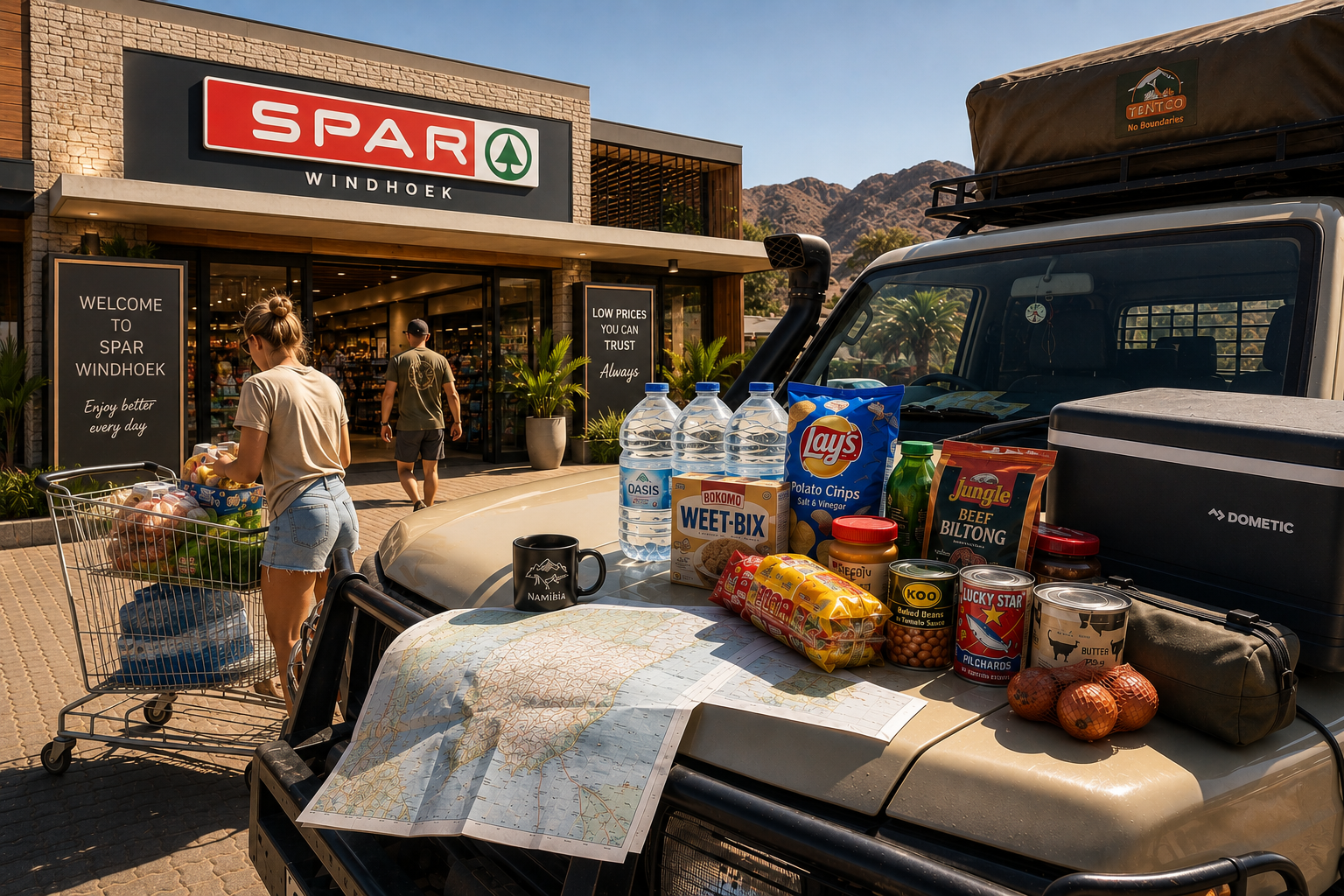
Your two main stops for food in Namibia are Windhoek (the capital city) and Swakopmund (a town on the Atlantic coast). Stock up heavily at both. Between these towns and the major destinations, shops become scarce, overpriced and unreliable. Long stretches of road have nothing for 200 to 400 kilometres.
If you have never been to Namibia before, here is the single most important thing to understand: this is not a country where you can stop for groceries whenever you feel like it. Namibia is roughly the size of France and Germany combined. It has fewer than 3 million people. Large parts of the country are pure desert with no towns, no shops and sometimes no mobile signal for hours at a time.
Knowing where to buy food in Namibia is one of the most important things you can plan before your trip. Get it right and you eat well every evening around a fire. Get it wrong and you are driving an extra 90 minutes to find a warm tin of beans and a packet of crackers.
You cannot bring meat, biltong, dairy, eggs or most fresh produce across the Namibian border from South Africa. This is a strict biosecurity rule to protect Namibia’s livestock from disease. It is enforced at every border crossing. Do not pack a cooler box with food from home. It will be confiscated or you will have to leave it behind. Read our full guide on what food items are allowed into Namibia before you pack anything.
Where you can buy food depends entirely on the route you take, and the route is what most people get wrong first. To have it worked out for you instead, Johan builds the route, the first call costs nothing, and a booking agency Mantis works with can book the stops.
Where to Buy Food in Namibia: Start in Windhoek
Windhoek is the capital and largest city of Namibia. It sits in the middle of the country and is where almost every self-drive trip begins. The supermarkets in Windhoek are modern, well-stocked and comparable to what you would find in South Africa or Europe. You can buy fresh meat, vegetables, fruit, bread, dairy, snacks, firewood, drinking water, cooking gas and anything else you need for a week or more on the road.
International visitors are often surprised by how good the shops are. This is your best and most reliable opportunity to provision properly. Do not rush it. A thorough shop in Windhoek saves you from paying two to three times the price for the same item at a remote camp shop four days later.
| Supermarket | What kind of store is it? | Where to find it in Windhoek | Best for |
|---|---|---|---|
| Food Lovers Market | A fresh food focused retailer with an excellent in-store butchery. Think of it as a high quality food hall with a great meat counter. | Near Grove Mall | Best fresh meat and vegetables in Windhoek. Go here first if you are self-catering. |
| Checkers | A large South African supermarket chain. Similar in size and range to a UK Sainsbury’s or a US Kroger. Well organised and reliable. | Grove Mall, Maerua Mall | Full grocery shop, good produce, competitive prices. |
| Spar / SuperSpar | An international franchise chain with large, well-stocked stores. The Namibian Spars are reliable and easy to navigate. | Maerua Lifestyle Centre and across the city | Groceries, snacks, good opening hours including weekends. |
| Pick n Pay | A South African chain found throughout southern Africa. Solid range and reliable stock levels. | Wernhil Park | General groceries and household goods at reasonable prices. |
| Woolworths | A premium South African retailer. Similar to Marks and Spencer in the UK. Higher prices but excellent quality ready-made meals and deli items. | Grove Mall | Quality prepared meals, good cheese and deli items. Useful if you want convenience food rather than cooking everything yourself. |
Windhoek is a real city. Parking at the malls is free and easy. Take an hour and do a proper shop. A thorough run at Checkers or Food Lovers in Windhoek will cost you far less than buying the same items at a camp shop in the middle of nowhere. It also means you arrive at each campsite with everything you need and nothing to worry about.
Knowing where to stock up only helps once you know your route, and the route is the part most people get wrong. Johan plans the drive around real distances, and a booking agency Mantis works with can book the lodges, the campsites and the vehicle before you land.
Swakopmund: Your Second Major Resupply Point
Swakopmund is a small town on the Atlantic coast of Namibia, about 360 kilometres west of Windhoek. It was built by German colonists in the late 1800s and still has a strong German character with colonial-era architecture, German restaurants and bakeries. The town sits at the edge of the Namib Desert where it meets the cold Atlantic Ocean.
Most self-drive routes pass through Swakopmund because it is the main coastal hub and a natural stopping point between Etosha National Park in the north and Sossusvlei in the south. The supermarkets here are smaller than Windhoek but well stocked. More importantly, the butcheries in Swakopmund are excellent. If you want to buy game meat for the rest of your trip, this is where to do it.
| Store | What to buy there | Notes |
|---|---|---|
| Food Lovers Market | Fresh meat, game cuts, vegetables, deli items | Highly rated butchery with knowledgeable staff. Best all-round option in Swakopmund for quality. |
| Namaqua Meat | Local butchery. Game meat, boerewors, traditional cuts. | Consistently recommended by locals and frequent visitors. Good for fresh cuts before heading into remote areas. |
| Checkers | Full grocery range | Reliable for everything else. Good stock levels. Easy to park. |
| Spar | Full grocery range | Good opening hours. Useful for top-ups if you are leaving early in the morning. |
What Is a Braai and Why Is Game Meat Worth Buying?
A braai is the southern African word for a barbecue or open-fire cookout. It is not just cooking outside. It is a cultural ritual. If you are self-catering and camping in Namibia, you will likely have a braai most evenings. Almost every campsite in Namibia has a built-in braai stand or fire pit.
Namibia produces exceptional game meat. Kudu, oryx and springbok are the three you will see most often in butcheries. These are large antelope species that live wild across Namibia. The meat is lean, flavourful and unlike anything available in a regular supermarket at home. It is also cheaper than beef at most Namibian butcheries. Trying game meat around a fire in the Namib Desert is one of the genuinely great food experiences of visiting this country. Buy it from a proper butchery in Windhoek or Swakopmund rather than from a camp shop fridge where selection is limited and prices are high.
Biltong is dried cured meat sold throughout Namibia. It is similar to beef jerky but typically better quality. You will see it at roadside stalls, petrol stations and supermarkets everywhere. It keeps for days without a fridge, which makes it ideal for long drives between towns. It is also one of the best snacks you can buy for a self-drive trip.
Where to Stock Up Before Each Major Destination
Every major destination in Namibia has a last reliable town before you get there. If you miss that town, you may be driving an extra hour to solve a problem that takes five minutes in a supermarket. Use the interactive finder below to check your specific destination, or scroll down to the full reference table.
Destination Stock-Up Finder
Select where you are heading to see the last good town, what to buy there and what to expect when you arrive.
Here is the full reference table covering every major destination.
| Destination | What is it? | Last good town | What to buy there | Shops on arrival? |
|---|---|---|---|---|
| Sossusvlei / Sesriem | Famous red sand dunes and a white clay pan. The entrance gate is called Sesriem. Top attraction in Namibia. | Windhoek or Rehoboth | Everything. Full shop. Do not rely on Solitaire en route. | Very limited Solitaire has fuel and a bakery only. |
| Etosha National Park | A massive wildlife reserve. You stay in fenced camps and drive yourself to watch animals at waterholes. | Outjo or Otjiwarongo | All meat, fresh food and fuel. No fuel inside the park. | Basic only Camp shops have bread, water and snacks. Expensive. |
| Fish River Canyon | Second largest canyon in the world. Remote southern Namibia. | Keetmanshoop | Full grocery shop. Last decent supermarket before the canyon. | Almost nothing Small camp shop at Hobas only. |
| Damaraland / Palmwag | Remote rugged region with desert elephants and ancient rock art. | Swakopmund, top up in Khorixas | Provision fully in Swakopmund. The further north you go the less you find. | Almost nothing Palmwag Lodge has a small shop. |
| Skeleton Coast | One of the most remote and dramatic coastlines on earth. Named after shipwrecks and whale bones. | Swakopmund then Henties Bay | Everything. Stock up like you are going on an expedition. | Nothing |
| Spitzkoppe / Brandberg | Dramatic granite mountains in the desert. Unfenced campsites with ancient rock paintings. | Swakopmund or Usakos | Water and firewood especially. No shops at either campsite. | Nothing |
| Lüderitz | Isolated German colonial town on the south Atlantic coast. A dead-end road trip destination. | Keetmanshoop | Full grocery shop. Last decent supermarket before the long drive in. | Limited Small Spar in town. Pricier than the mainland. |
Which Supermarket Chains Will You Find in Namibia?
Unlike some parts of Africa, Namibia has a reliable network of supermarket chains in its larger towns. The stores are clean, well lit and carry a good range. Here is what to look for as you drive through each town.
What About the Camp Shops Inside Etosha?
Etosha has three main rest camps where you stay overnight: Okaukuejo, Halali and Namutoni. Each has a small shop inside the fenced camp. They stock the basics: bread, milk, water, charcoal, beer, wine, ice cream, biltong and snacks. You will not go hungry if you buy there.
The downside is that the prices inside Etosha are noticeably higher than in town. Most self-catering travellers stock up in Outjo before entering the park and treat the camp shops as top-up stops only. There is also one important rule you cannot ignore: you cannot take any meat out of Etosha when you leave. There is a veterinary inspection fence at every exit gate and it is actively enforced. Whatever meat you bring into Etosha must be eaten inside Etosha. Plan your quantities accordingly.
Do You Need Cash to Buy Food in Namibia?
Yes. This catches more first-time visitors out than almost any other practical issue. Always carry cash. The Namibian dollar (N$) is the official currency. South African rand is accepted everywhere at a 1:1 exchange rate. If you are coming from South Africa you do not need to exchange any currency. If you are arriving from elsewhere, draw Namibian dollars from an ATM in Windhoek on arrival.
| Where | Cards accepted? | Cash needed? | Notes |
|---|---|---|---|
| Major supermarkets in Windhoek and Swakopmund | Yes, reliably | No, but carry some anyway | Card machines work well at city-level stores. |
| Smaller town supermarkets (Outjo, Keetmanshoop, Khorixas) | Usually | Recommended | Cards often work but machine failures happen. Have backup cash. |
| Remote campsites | Often not | Yes, essential | Many campsites are cash only. Camp fees run from N$150 to N$300 per person per night. |
| Petrol stations on remote routes | Unreliable | Yes, essential | Do not assume cards work at remote stations. Fill the tank whenever you can and always carry cash. |
| Roadside biltong and craft stalls | No | Yes | Always cash only. These stalls are worth stopping at. |
Draw cash at an ATM in Windhoek before you leave the capital. Aim for N$500 to N$1000 in mixed notes including some small denominations. ATMs exist in smaller towns but are often empty, out of service or inconveniently located. Do not solve this problem in a remote town when you are already three days deep into the desert.
What About Firewood?
Firewood is one of the things first-time visitors most commonly forget to plan for. Most campsites in Namibia do not provide it. You are expected to bring your own or buy it at the last town before camp. And in the Namib Desert there is almost no dead wood lying around to collect.
| Option | Where to get it | Notes |
|---|---|---|
| Bundles of hardwood | Supermarkets and petrol stations in every larger town | Best option. Namibian hardwood burns long and hot. Buy before leaving each town on your route. |
| Charcoal bags | Most supermarkets | Reliable backup if you cannot find wood. Lights easily and works well in a braai stand. |
| Camp shop firewood | Etosha camps and some lodges | Available but more expensive than buying in town. Do not rely on it being in stock. |
| Collecting from the bush | Only allowed on private farms or community campsites that explicitly permit it | Not allowed in national parks. The desert has almost no dead wood anyway. Do not plan around this. |
Your Pre-Trip Provisioning Checklist
Use this before you leave Windhoek. Tick each item off before you get on the road.
- Meat bought from Food Lovers Market or a good butchery. Consider buying kudu, oryx or springbok if you want to try something local.
- Firewood or charcoal. Enough to cover every night until you reach your next major town.
- Drinking water. At least 2 litres per person per day. More in summer months (October to April) when temperatures can exceed 40 degrees.
- Road snacks that keep without refrigeration. Biltong, dried fruit, nuts, rusks, crackers.
- Tinned goods for remote nights. Tinned fish, beans, tomatoes and soup. Backup for when fresh food runs out.
- Cooking basics. Oil, salt, pepper, braai spice (a seasoning mix sold at every Namibian supermarket and essential for braaing).
- Cash from ATM. N$500 to N$1000 in mixed notes. Do this in Windhoek, not in a smaller town later.
- Ice for the cooler box. Most Namibian petrol stations sell bags of ice. Buy it often on the road.
- Bread, butter and eggs for breakfasts on the road.
- Identified the next stock-up town on your route and noted what to buy there.
Key Takeaways
- Windhoek first, always. Do your main shop here before leaving the capital. It is the best-stocked city in the country.
- Swakopmund is your second chance. Best butcheries outside Windhoek. Stock up here before heading north or into remote areas.
- Know your last town before each destination. Once you pass it, shops disappear. Use the table above before every leg of the trip.
- Always carry cash. Remote campsites, fuel stations and roadside stalls are cash only. Get it in Windhoek before you leave.
- Buy firewood in town. You will not find any in the desert. Most campsites do not provide it.
- Etosha meat rule. Any meat you bring into Etosha cannot leave. Plan your quantities and eat everything inside the park.
- South Africans: no food across the border. Meat, biltong, dairy and fresh produce will be confiscated. Buy everything once you are in Namibia.
For more on planning your route and what roads to expect between these towns, read our Namibia self drive safari guide. If you are still deciding which areas to visit, our breakdown of the top 5 places to visit in Namibia is a good starting point. And if you are driving from South Africa, check what food items are allowed into Namibia at the border before you pack anything.
We tell you exactly where to stop, what to buy, where to stay and what your vehicle can handle. No guesswork, no expensive surprises three days into the desert. Book a free call with Mantis Eco Adventures.
For park bookings and access information, visit Namibia Wildlife Resorts directly.
Also check out these guides before you go:
Namibia Travel Guide 2026: Essential Tips Before You Go
Namibia on a Budget: What It Actually Costs in 2026
Top 5 Places to Visit in Namibia