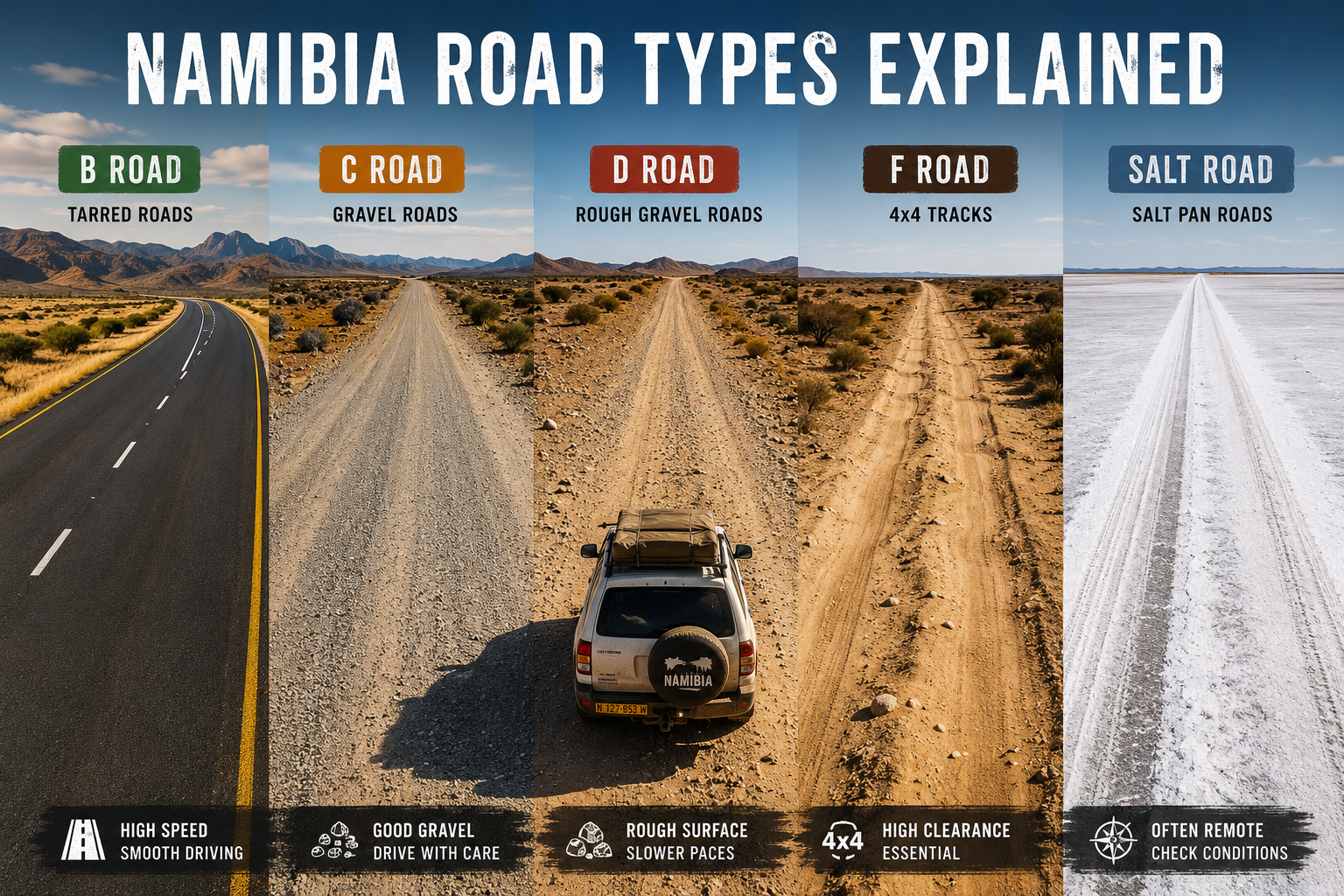
You are looking at a map of Namibia. Every road has a letter in front of its number. B1, C14, D845, F-something. Nobody explains what those letters mean. You search for help and find a vague mention that C roads are gravel and D roads need a 4×4. That is not wrong but it is not nearly enough to plan a trip on. The namibia road types system affects how long every drive takes, what vehicle you need, what speed is actually safe and what happens to your tyres if you get it wrong. This guide explains all of it plainly.
Road types decide your vehicle, your daily distance and where you can realistically stop. Getting that wrong is the most expensive mistake on a Namibia trip. Johan matches the route to the vehicle, and a booking agency Mantis works with can book the whole trip.
Why Namibia Road Types Matter More Than You Think
Only about 40 percent of Namibia’s roads are tarred. The other 60 percent are gravel, compacted earth, sand or salt surface. That means the majority of driving you do on a self drive trip in Namibia is not on roads that behave like the ones at home. A standard sedan handles a tar highway fine. That same sedan on a badly corrugated D road will shake itself apart and leave you with a blowout 80km from the nearest town.
The other problem is Google Maps. It calculates driving times based on distance and posted speed limits. It does not account for corrugation, soft sand, river crossings, mountain passes or the fact that you need to stop before dark. A 200km stretch of C road that Google calls two hours can realistically take four. A D road section that looks like a short detour can add two hours and a puncture to your day. Understanding namibia road types before you plan your daily distances is not optional. It is the difference between arriving at your campsite in daylight and arriving at midnight wondering what went wrong.
What Are the Different Namibia Road Types?
Namibia’s Roads Authority classifies public roads by letter. Each letter tells you something specific about the surface, the maintenance frequency and what to expect behind the wheel.
B Roads: The Easy Ones
B roads are Namibia’s national highways and they are all tarred. The B1 runs the length of the country from north to south and is the backbone of most itineraries. B roads are well maintained, clearly signposted and driveable at normal highway speeds. If you have never driven in Namibia before, the B roads will feel completely familiar. The speed limit is 120km/h though 100km/h is a sensible cruising speed until you are comfortable with the local conditions, particularly the livestock and wildlife that cross freely on unfenced stretches.
C Roads: Where Most of Your Trip Happens
C roads are Namibia’s secondary road network and they are gravel. Most of the popular tourist routes run on C roads. The C14 from Windhoek toward Sossusvlei, the C19 connecting Sesriem to Swakopmund, the C34 along the Skeleton Coast. These roads are regularly graded by the Roads Authority and are wide enough for two vehicles to pass comfortably. In good condition a C road is perfectly manageable in a high-clearance SUV. The catch is corrugation.
Corrugation is what happens when traffic and heat compact gravel into ridges running across the road. It builds up between grading passes and on busy stretches it can get severe. Corrugated gravel at speed shakes the vehicle constantly, wears tyres faster and makes a four-hour drive feel like eight. Reduce your tyre pressure slightly on C roads, drop your speed on badly corrugated sections and never brake or turn sharply on loose gravel. Braking distances are considerably longer than on tar.
Note that Namibia has been gradually reclassifying and renumbering roads in recent years, with some D roads upgraded to C roads and their numbers changed. Local signposts can be slower to update than the maps. If a road looks better than expected, it probably was a D road recently. If it looks worse than a C road should, the grader has not been through recently.
D Roads: Where It Gets Interesting
D roads are narrower, maintained less frequently and can vary enormously in condition. A D road that was graded recently can be perfectly driveable in a standard SUV. A D road that has not been touched in months after rain can be deeply rutted, heavily corrugated or sandy enough to swallow a 2WD. You genuinely do not know which one you are getting until you are on it. That variability is the defining feature of D roads.
The D845 between Solitaire and Sesriem is a common D road on the main tourist circuit and it is usually fine. Some D roads in the NamibRand area are notorious for catching people out with sandy stretches that appear without warning. A 4×4 is strongly recommended for any D road you have not driven before and essential for D roads in remote areas or after rain.
F Roads: Not for Most Visitors
F roads are essentially unformed tracks. They have no meaningful maintenance schedule and they exist on maps largely because someone drove that way once and the route was formalised. Some F roads are genuine off-road tracks through rough terrain. Others are sandy farm tracks on private land. Either way they are not part of any standard tourist itinerary and attempting them without a proper 4×4, recovery equipment and experience is how people end up needing a helicopter. Unless someone who knows the specific track well has recommended it for your vehicle and skill level, leave F roads off your route entirely.
Salt Roads: The Coastal Wildcard
Salt roads are a surface type found almost exclusively along Namibia’s Atlantic coast. They are not classified separately by letter but often appear as C roads on maps. The C34 from Swakopmund up the Skeleton Coast is the most well-known example. Salt roads are made from a compacted mixture of salt, gypsum, sand and gravel baked hard by the sun. In dry conditions they can feel smoother and faster than regular gravel, which is exactly the trap. The smoothness encourages speed and the braking distances on salt surface are longer than on regular gravel. In wet conditions, after rain or in heavy coastal fog which is common in this area, salt roads become genuinely slippery. Treat them like ice. Slow down, avoid sharp braking and give yourself far more stopping distance than feels necessary.
Well maintained, signposted
Regularly graded
Condition varies widely
No maintenance
Coastal areas only
How Do Namibia Road Types Affect Your Driving Times?
This is where most people go wrong with their planning. The speed limit on tar is 120km/h. On gravel it is 80km/h. In practice on a badly corrugated C road you are driving 50 to 60km/h to protect your tyres and your sanity. On a rough D road stretch you might be down to 30km/h. The practical rule is to double the Google Maps estimate for any route that is predominantly gravel and add extra time for D road sections.
| Road Type | Legal speed limit | Practical safe speed | Google Maps accuracy |
|---|---|---|---|
| B road (tar) | 120km/h | 100km/h until familiar | Reasonably accurate |
| C road (gravel) | 80km/h | 60km/h on corrugated sections | Underestimates by 50 to 100% |
| D road (gravel/sand) | 80km/h | 30 to 50km/h depending on condition | Severely underestimates |
| Salt road | 80km/h | 60km/h dry, much slower when wet | Underestimates by 30 to 50% |
Rental companies fit all vehicles with a speed tracking device. Exceeding the gravel road limit and then having an accident voids your insurance cover. Beyond the insurance risk, gravel at speed destroys tyres. Flying stones chip windscreens at 80km/h. The limit is there for a reason and experienced Namibia drivers treat 60km/h as the sensible ceiling on most gravel roads, not the conservative option.
Which Vehicle Do You Need for Each Road Type?
The mismatch between vehicle and road type is the most common and most expensive mistake on a Namibia self drive. Renting a soft-roader AWD and heading onto D roads near Damaraland or the NamibRand area is how people end up with recovery fees that dwarf the cost of the right rental in the first place.
B roads take any vehicle. C roads need a high-clearance vehicle with decent tyres. Ground clearance matters more than four-wheel drive on most C roads because the corrugation and occasional rocky section will ground out a low-clearance car before traction becomes the issue. D roads genuinely need a 4×4 with a diff lock for anything beyond a recently graded section in dry conditions. F roads and the deep sand of the Sossusvlei dune track need a proper 4×4 with low-range gearing, full stop.
The salt roads along the coast are an exception. They are technically C roads and a high-clearance SUV handles them fine in dry conditions. The variable is weather, not vehicle specification. Our 4×4 vs 4WD guide for Namibia breaks down exactly what the mechanical difference means on the ground if you are trying to decide between rental options.
Practical Tips for Each Road Type
Tyre Pressure by Surface
Tyre pressure is the one adjustment most people do not know about until they get a puncture. On tar roads run at the manufacturer’s recommended pressure. On gravel roads reduce by 0.2 to 0.3 bar to soften the tyre and reduce puncture risk from stone strikes. On deep sand like the Deadvlei track reduce to 1.2 to 1.5 bar so the tyre footprint widens and you float over the surface instead of digging in. Critically, inflate again before you return to tar. Driving at sand pressure on a tar road at speed damages tyres and affects handling. Always re-check pressure at the next fuel stop after a road surface change.
River Crossings on D Roads
Namibia’s ephemeral rivers cross many D roads at concrete fords rather than bridges. In dry season these are simply dips in the road. After rain they can have flowing water. Never drive into a flowing river crossing without knowing the depth. If the water is above knee height on an adult do not cross. Wait for it to drop. The gradients on these dips can also be steep enough to ground out your vehicle’s undercarriage if you hit them at speed. Approach all river crossings slowly regardless of conditions.
What to Watch for on Salt Roads
Coastal fog rolls in off the Atlantic without warning, particularly between Swakopmund and the Skeleton Coast on the C34. Fog on a salt road reduces visibility fast and makes the surface wet and slippery. Reduce speed dramatically when you enter fog, use your lights and increase the gap to any vehicle ahead of you. The C34 between Swakopmund and Henties Bay was tarred in 2019 but the sections further north toward Torra Bay remain salt surface and should be treated accordingly.
Which Roads Do the Main Tourist Routes Use?
Most first-time visitors cover a circuit of Windhoek, Sossusvlei, Swakopmund and Etosha. Here is what that actually involves by road type so you can plan your driving days accurately. For a full day-by-day route breakdown see our Namibia self drive itinerary guide.
| Drive | Distance | Road types | Realistic time |
|---|---|---|---|
| Windhoek to Sesriem | ~340km | B1 tar south then C19 and D845 gravel | 4.5 to 5.5 hrs. Leave by 8am. |
| Sesriem to Swakopmund | ~350km | Mostly C14 and C19 gravel. Roughest stretch on the main circuit. | 6 to 7 hrs. Leave at dawn. |
| Swakopmund to Etosha (Anderson Gate) | ~500km | B2 tar to Usakos then mix of B and C through Outjo | 5 to 6 hrs. Stock up in Outjo. |
| Etosha to Windhoek | ~430km | Mostly B1 tar from the south gate | 5 hrs. Most comfortable drive on the circuit. |
| Keetmanshoop to Fish River Canyon (Hobas) | ~175km | B1 tar then D601 gravel into Hobas | 2.5 to 3 hrs. Short but the gravel section slows the last stretch. |
| Sesriem camp to Deadvlei parking | ~65km | Paved to 2WD lot then 5km deep sand | 1 to 1.5 hrs. 4×4 for the sand or take the shuttle. |
Is It Safe to Drive Namibia’s Gravel Roads?
Yes, with the right vehicle and the right approach. Namibia’s main C roads are well graded and thousands of visitors drive them every year without incident. The risks come from three things: speed, darkness and the wrong vehicle. Drive at the right speed for the surface, be at your campsite before sunset and match your rental to your actual route. Those three decisions eliminate the vast majority of problems.
Wildlife is the other factor that the road classification system cannot help you with. Animals cross all road types at all hours. Kudu, warthog, gemsbok and cattle move freely on unfenced roads throughout Namibia. Never drive after dark regardless of what road type you are on. The Namibia self drive safari guide covers the safety side of driving in more detail if you want the full picture before you go.
Rain changes everything. A C road that is fast and firm in dry season can become deeply corrugated or partially washed out after heavy rain. A D road can become completely impassable. If you are travelling in the wet season from November to April, build extra time into every driving day and have a plan B for any D road sections on your route.
If you want a route planned around your specific vehicle, travel dates and the road types you are comfortable with, a custom itinerary from Johan is the most useful investment before you book anything. We know which roads are in good condition, which ones to avoid in the wet and which shortcuts are worth taking and which are not.
For park bookings and access information, visit Namibia Wildlife Resorts directly.
Also check out these guides before you go:
Namibia Travel Guide 2026: Essential Tips Before You Go
Namibia on a Budget: What It Actually Costs in 2026
Top 5 Places to Visit in Namibia