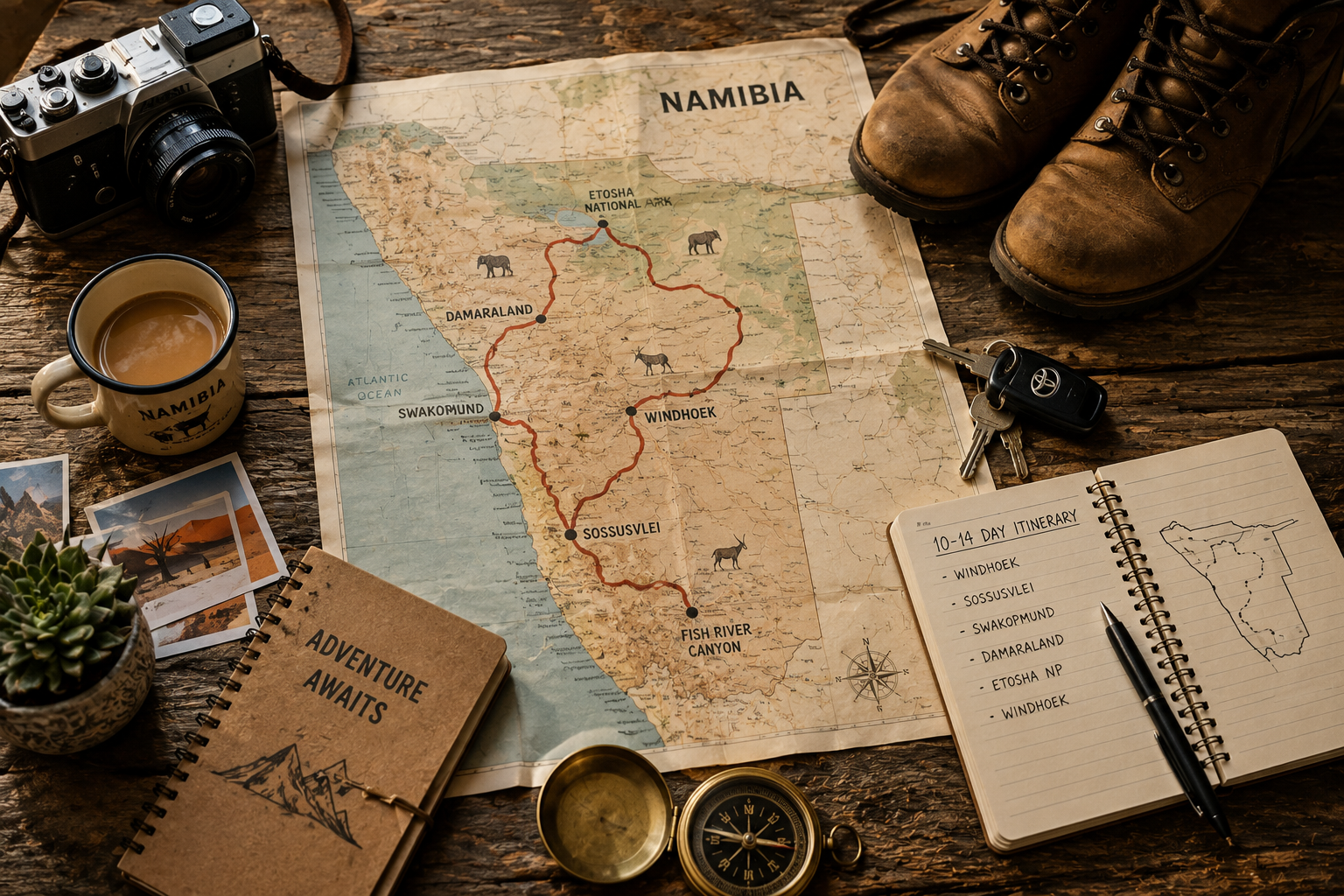
You want to plan a Namibia self drive and you do not want to figure it out the hard way on a gravel road 200km from the nearest town. Good. This guide gives you a working 10 to 14 day route with driving times that reflect what the roads actually do to your schedule. Everything here comes from people who have done these roads, not from someone zooming in on Google Maps.
A route on a page is a starting point. Turning it into dates, beds and gate times is the part that takes local knowledge, and Johan does that for EUR 100 after a call that costs nothing.
How Long Do You Need to Plan a Namibia Self Drive?
Ten days is the realistic minimum for the main circuit. Twelve to fourteen days gives you room to breathe and actually enjoy where you are instead of racing to the next stop. The biggest mistake first timers make is underestimating how long the drives take.
Google Maps gives you tarmac times. Most of Namibia is gravel. A 200km stretch that looks like two hours on a map can easily take four to five hours on corrugated gravel in the dry season. After rain, even longer. The practical rule is to double the Google Maps estimate for any route that includes gravel. If you want to understand exactly why, our guide to how Namibia’s road classification system works explains what each road letter means for your vehicle, your speed and your daily driving plan.
The Real 12 Day Route (With a 14 Day Option)
This is the route most first time visitors should plan a Namibia self drive around. It covers the highlights without leaving you exhausted. Use it as a base and adjust based on your interests and pace.
| Day | Route | Distance | Notes |
|---|---|---|---|
| 1 | Arrive Windhoek | n/a | Pick up your rental, stock up on supplies at Woolies or Checkers, fill the tank. Do not skip this step. |
| 2 | Windhoek to Sesriem | 340km | Mostly tar then gravel. Allow 4 to 5 hours. Stay inside the park if you can get a booking. |
| 3 | Sossusvlei and Deadvlei | n/a | Leave before sunrise. The Sesriem gate opens an hour earlier for guests staying inside the park. If you are outside the gate you will queue behind everyone who is. The N$200 shuttle runs from the 2×4 car park to Deadvlei if you do not have a 4×4. |
| 4 | Sesriem to Swakopmund | 350km | The longest and roughest stretch of the trip. Mostly corrugated gravel via the C19 and C14. Allow 6 to 7 hours. Leave early. You will pass through Solitaire (bakery and limited fuel, do not count on it for anything else). |
| 5 to 6 | Swakopmund | n/a | Two nights minimum. Dolphin cruise from Walvis Bay, sandboarding, quad bikes, excellent restaurants. Try Joe’s Beerhouse for game meat. This is one of the most enjoyable towns on the route and your chance to stock up on supplies before heading north. |
| 7 | Swakopmund to Spitzkoppe | 130km | Short drive. The community campsite at Spitzkoppe is one of the best on the route. Stay the night for the sunset and stars. No facilities beyond basic toilets so bring everything you need. |
| 8 | Spitzkoppe to Damaraland | 250km | Half day drive. Visit the rock engravings at Twyfelfontein. Desert adapted elephants if you are lucky. One night is enough for most travellers. Add a second night if you want to track elephants with a local guide. |
| 9 | Damaraland to Etosha (Anderson Gate) | 300km | Stock up on supplies in Outjo (last proper town). Enter through Anderson Gate on the south side. Full afternoon game drive before dark. |
| 10 to 11 | Etosha National Park | varies | Two full days minimum. The waterholes are the strategy. Park yourself at one, turn off the engine, and let the animals come to you. Okaukuejo’s floodlit waterhole is worth a visit after dark. |
| 12 | Etosha to Windhoek | 430km | All tar via the B1. Allow 5 hours. Return your vehicle, fly out or overnight in Windhoek. |
Which Vehicle Do You Actually Need?
On this loop a high clearance SUV handles the main C roads and Etosha’s gravel. The exception is Deadvlei, where the last 5 km from the 2×4 car park is deep sand that needs a true 4×4 with low range. Without one, take the shuttle, about N$200 (USD $11 / €10) per person. Damaraland tracks, D roads and the Skeleton Coast beyond Cape Cross need a genuine 4×4. The 4×4 versus 4WD guide matches vehicles to roads, and the self-drive guide covers renting, tyres and gravel driving.
What Is the Best Time of Year?
May to September suits this route best. The roads are at their best, the heat is manageable and Etosha’s animals crowd the waterholes. Book Sesriem and the Etosha camps at least three months ahead for July and August. From December to April some roads, including the Deadvlei access road, can become impassable. The month by month guide has the rest.
Where Do You Buy Food and Supplies?
On this route you stock up three times. Windhoek on day one, because Sesriem has almost nothing. Swakopmund on days five and six, before heading north. Outjo, the last proper town before Etosha’s Anderson Gate. Solitaire has a bakery and limited fuel but is not a plan. Where to buy food in Namibia covers every stop, and if you drive in from South Africa, check what food you can take across the border first.
How Much Does a Namibia Self Drive Actually Cost?
The vehicle is the biggest cost, then accommodation, fuel for roughly 3,000 km, food and park fees. Park fees rose on 1 April 2026, so older budgets online are too low. The full self-drive cost breakdown has current line by line budgets for camping, a mix and lodges, and if you drive your own car from South Africa, leave out the rental but check your insurance covers Namibia.
Should You Self Drive or Book a Guided Tour?
Self drive is better for most people who have decent road confidence and are willing to plan properly. You move at your own pace, you stop where you want, and you spend a fraction of what a guided tour costs. People who have done both usually prefer self drive for the freedom it gives you.
A guided tour makes sense if you are genuinely uncomfortable with remote driving, if you have no experience with gravel roads, or if you want someone else handling every detail. The Skeleton Coast specifically is worth doing with a guide or operator because access is restricted, roads are challenging, and the knowledge of a local guide adds real value there.
There is also a middle option that most people do not know about. You can rent a vehicle and hire a local guide to ride along for specific sections. Into Damaraland to track desert elephants, for example. You get the self drive freedom for the rest of the trip and expert eyes for the parts where it matters most.
Is Namibia Safe for a Self Drive?
Yes. Crime against tourists on self-drive routes is rare, and solo travellers drive this loop regularly. The real risks are breakdowns, heat and flat tyres far from help, so carry water, check the spare before you leave the rental lot and never drive after dark. The full safety guide has the detail, and a tyre pressure guide for your vehicle is part of Johan’s custom itinerary.
The Most Common Mistakes When You Plan a Namibia Self Drive
On this route the mistakes that hurt most are trusting Google Maps for driving times, arriving after dark, booking Sesriem and the Etosha camps too late, and squeezing too many kilometres into too few days. The self-drive guide goes through each one and how to avoid it.
Plan Your Namibia Self Drive Properly
The difference between a great trip and an expensive disaster in Namibia usually comes down to one thing. Planning. The right vehicle on the right roads at the right time of year with the right provisions and realistic driving days. Get those right and the rest takes care of itself.
If you want a custom route built around your group size, budget, vehicle and how many days you have, Johan has been driving these roads for over 25 years. He will tell you which version of this route makes sense for you, which roads to avoid based on current conditions, and where to sleep. For €100 (USD $110 / R2,000) you get a complete itinerary you can hand to your co pilot on day one and follow from start to finish. Book a free call and go with a plan that actually works.
For park bookings and access information, visit Namibia Wildlife Resorts directly.
Also check out these guides before you go:
Namibia Travel Guide 2026: Essential Tips Before You Go
Namibia on a Budget: What It Actually Costs in 2026
Top 5 Places to Visit in Namibia