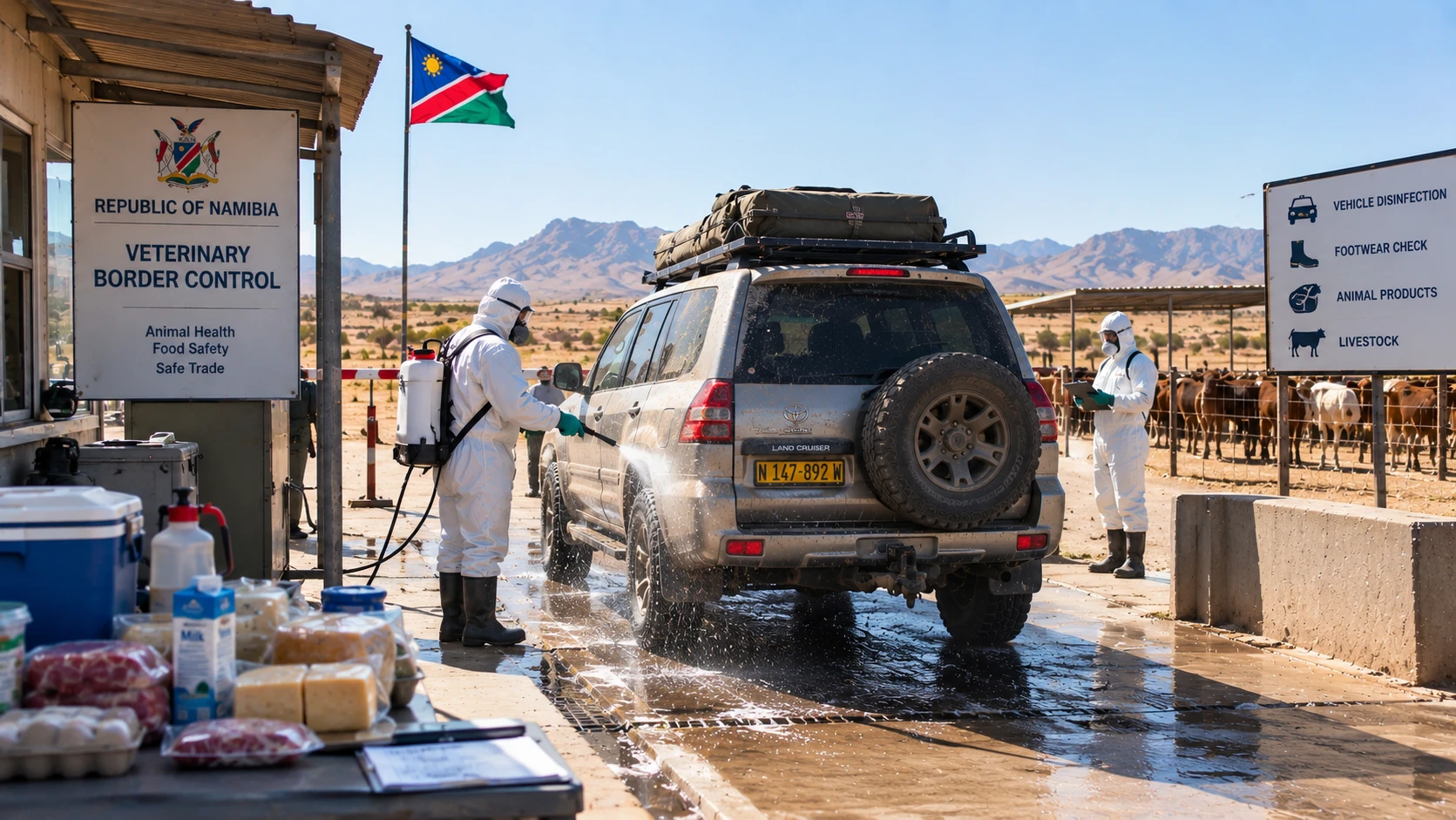
TL;DR: Namibia confirmed foot and mouth disease on a farm in the Karasburg district on 23 September 2026, the first case in its disease free south in about 60 years. By 6 October there were 129 positive samples on 17 farms in //Kharas, and a second outbreak had been reported in the Zambezi Region. People can still cross the border and travel normally. What is restricted is cloven hoofed animals and their raw products, and roadblocks are enforcing it. Since 27 September, meat bought from a shop may move south of the veterinary fence if you can show proof of purchase, but the //Kharas region, where you arrive from South Africa, stays under the full restrictions. Do not bring meat or biltong across the border, keep every till slip, and expect no end date yet.
Last checked 12 October 2026. This story is moving week by week. Every rule below is attributed to its source with a date, and where nothing official has been published we say so rather than guess.
If you are driving up from South Africa in the next few weeks, the outbreak is in the stretch you cross first. Nobody is closing the road to people. What changes is what you can carry in the cooler box. If you would rather not work out which side of the fence each night falls on, Johan can route your trip around the checkpoints and plan the meals so nothing gets confiscated, starting with a free call.
What happened with foot and mouth disease in Namibia?
On 22 September 2026 state vets found 63 cattle with signs of foot and mouth disease on a commercial farm in the Karasburg district of //Kharas. Eleven were sampled and ten tested positive at the Central Veterinary Laboratory in Windhoek the next day, according to the Veterinary Public Notification No. 15 of 2026 signed by the Chief Veterinary Officer on 23 September.
The farm sits south of the veterinary cordon fence, inside the zone Namibia had kept free of the disease without vaccination. The World Organisation for Animal Health status for that zone was suspended from 22 September, as reported by the BEACON outbreak service on 24 September. By 30 September the count had risen from three farms to five, all still in the Karasburg district, according to Informanté. As of 6 October the count was 129 positive samples on 17 farms, according to The Namibian on 9 October. The European Union has also temporarily suspended fresh meat of cattle, sheep and goats from Namibia’s disease free zone, in a measure published on 5 October.
The disease hits cattle, sheep, goats, pigs and wild cloven hoofed animals. It is not harmful to people, as University of Pretoria researcher Tania Prinsloo noted in The Conversation.
Is there foot and mouth disease in the Zambezi Region?
Yes. The ministry reported a second outbreak on 11 October, on Kalala Island in Kabbe constituency. Vets found 20 sick cattle on 5 October and all 12 samples tested positive on 7 October, according to The Namibian on 11 October. Anews and The Economist reported the same on 12 October. The ministry suspended the movement of all cloven hoofed animals and their raw products throughout the region, cancelled existing permits and set up roadblocks at strategic locations. This matters because the Zambezi (Caprivi) strip is the self drive road to Victoria Falls, Chobe and Botswana. The sources say nothing about tourists, so expect roadblocks on that road and carry no raw meat or other raw animal products through the region.
What the official notice actually restricts
Notice No. 15 put six measures in place “with immediate effect until further notice”.
| Measures in force from 23 September 2026 |
| Movement. No movement anywhere in Namibia of cloven hoofed animals or their raw products. |
| Trade. No marketing or trade of cloven hoofed animals. |
| Borders. Imports, exports and transit of these animals and their raw products suspended. |
| Slaughter. Halted at export and local abattoirs, informal markets and social events. |
| Surveillance. Intensive testing to find the full extent of the outbreak. |
| Roadblocks. Set up at strategic areas to enforce the movement controls. |
Notice the word raw. It matters for what you can carry, and it is why the partial lifting a few days later changed the picture for travellers in most of the country but not in the far south.
Can I still drive into Namibia from South Africa?
Yes. Neither the 23 September notice nor the 27 September update closes any border to people or vehicles. The restrictions are on animals and animal products. You still cross at Noordoewer or Ariamsvlei as normal.
Expect more checking, though. The Namibian reported on 30 September that the agriculture ministry had already put staff at points of entry for disinfection and product checks before the outbreak, first on the Botswana border and then on the South African one. This week the Namibian Sun posted advice for anyone entering Namibia that included disinfecting your vehicle. Stepping onto a disinfectant mat at the border was routine before the outbreak, as our guide to what food you can bring into Namibia describes.
Once you are through, what you may carry depends on where in Namibia you are.
Can I bring meat or biltong into Namibia?
No meat. Do not bring it. Notice No. 15 suspends imports of cloven hoofed animals and their raw products, and Farmer’s Weekly reported on 23 September that the import and export suspension covers meat products, dairy products and hides until further notice. Beef, lamb, pork and goat from South Africa are all cloven hoofed meat.
Biltong is the grey area, and nobody official has cleared it up. The 27 September update, as reported by New Era, allows processed meat to move within Namibia. None of the published sources says whether biltong counts as processed or raw for this outbreak, or whether that allowance applies at the border at all. With South Africa fighting what BEACON called its worst outbreak in years, assume the answer at the border is no.
The normal rules have not relaxed either. Dairy, fresh produce and firewood were already restricted before any of this, and nothing in the outbreak notices loosens them.
Will my meat be confiscated at a roadblock or the red line?
It depends on which side of the veterinary cordon fence you are on, and whether you are still in //Kharas. The fence, which people in Namibia call the red line or rooilyn, runs across the north of the country and separates the disease free south from the northern communal areas. Moving meat across it was controlled long before this outbreak. Since 27 September the rules either side of it are different, according to the partial lifting reported by Informanté on 27 September, New Era on 28 September and The Namibian on 29 September.
Expect to be stopped and checked in //Kharas. The Namibian reported on 9 October that 16 veterinary checkpoints have been operating since 25 September, and that meat found in breach of the restrictions has been confiscated and destroyed. Vets inspect vehicles and disinfect them, including at the Karasburg-Warmbad four-way junction. Cabinet approved a containment plan on 4 October that creates a buffer zone in the Karasburg veterinary district, repairs parts of the Botswana border fence and puts up veterinary cordon fencing in high-risk areas along the South African border. Expect to stop, and expect your vehicle to be sprayed.
| Meat rules by area, as reported 27 to 29 September 2026 |
| //Kharas region. All restrictions remain. This is where the outbreak is, and where you arrive from Noordoewer or Ariamsvlei. No published allowance for moving shop bought meat here. |
| South of the fence, outside //Kharas. Meat bought from a shop or butchery may be moved if you can show proof of purchase. Raw meat from registered abattoirs, butcheries and cold stores may move with papers showing where it came from. |
| Crossing the red line going north. Still restricted. Animals and products such as meat, skins, unpasteurised milk and butter may not go north of the fence. |
| North of the fence. Movement restrictions lifted for the northern regions. The protocol for taking cooked meat, pasteurised milk and butter from north to south has resumed. |
| Home slaughter. Allowed for your own use, but the meat may not be moved off the property. |
Roadblocks are real and not only in the south. Informanté reported on 25 September that roadblocks on the routes into Windhoek were on high alert for raw animal products, with an allowance for purchased, properly packaged meat if you have proof of purchase. That allowance was then written into the wider update two days later.
Keep every till slip
In practice the till slip works like a permit. If you buy chops in Windhoek for a braai at your next campsite, the receipt is what separates legal meat from confiscated meat at a roadblock. Keep the meat in its shop packaging with the slip in the cooler bag.
Travellers were confused even before this. In a South African 4×4 forum thread titled “Restrictions on moving Meat”, three members argued over whether cooked meat could cross the red line north to south or south to north, one of them two days after the rules had already changed again. Forum reports from before the outbreak describe Etosha gates asking about meat and checking fridges on the way out, with different travellers getting different treatment. Locals are unsure too, so plan on the strictest reading.
Are lodges and restaurants still serving beef?
In Windhoek, yes. The Namibian spoke to two Windhoek restaurants on 1 October. Both were still serving beef, pork and lamb, had not raised menu prices and had not dropped dishes, though one had delivery delays and was sourcing from several butchers.
Shops have been patchier. The first days brought panic buying. A Keetmanshoop member of the 4×4 forum reported a run on red meat in Swakopmund and Walvis Bay and only three or four days of stock in Keetmanshoop around 25 September. On 29 September he reported one Keetmanshoop shop raising wors from N$109 to N$159 a kilogram and beef and lamb by N$60 a kilogram, and a Windhoek member saw pork at N$199 a kilogram. Those are single shops on single days, not a national price. The USDA report of 29 September says pork slaughter and trade were still suspended nationwide, causing shortages and price spikes.
For lodges outside Windhoek we found no published reporting either way as of 2 October. If meat matters to your stay, ask the lodge when you confirm. Most self drivers will simply buy as they go, and our town by town list of where to shop in Namibia shows where the bigger supermarkets are. Prices may run higher than our normal food budget figures for a while.
Does it affect Etosha, game drives or the Botswana border?
No source we have seen reports any park, game drive or lodge closing because of the outbreak, as of 2 October 2026. The notices restrict animal movement, trade and slaughter, not visitors.
Wild cloven hoofed animals can carry the disease. The World Reference Laboratory for foot and mouth notes that all three SAT types of the virus are endemic in African buffalo. That is the background to the existing fence, not a new restriction on game viewing.
Does South Africa have foot and mouth disease?
Yes, and so do Botswana and Zambia. African Farming listed all three as having active outbreaks on 30 September. The Namibian reported a ministry letter of 3 September saying affected South African sites were within 100 km of the Namibian border. We found no outbreak specific guidance yet for the Botswana crossings, and no South African guidance on bringing Namibian meat back. The export suspension in Notice No. 15 means you should not plan on taking meat or biltong home either.
How long will the foot and mouth restrictions last?
Nobody official has given an end date. Both notices run “until further notice”. On 30 September the agriculture minister said not to expect any further easing until the 14 day incubation period had passed, according to Informanté.
The only figures beyond that are not official. A member of the 4×4 forum wrote that a ban usually lasts 90 days after the last detection, which is one person’s view. The last big outbreak, in the northern communal areas in 2015, spread to more than three regions in under five months and was eradicated within a year, with the area declared free in January 2016, according to The Conversation. Getting the international disease free status back is a separate process from lifting the local movement rules.
We will update this page when the Directorate of Veterinary Services publishes its next notice.
Planning a trip during the outbreak
Cross with no meat, buy as you go, and keep the slips. If you are coming up the N7, our Cape Town to Namibia road trip crosses at Noordoewer, and your first stretch inside Namibia is in //Kharas, so plan those first meals around pasta, tins and anything that is not red meat. Save the braai for when you are north of //Kharas with a receipt in your hand.
Route order matters more than usual. A loop that goes north of the red line and comes back south is fine for you. Your meat is another matter. Meat from the south cannot go north, and the only published route south is the protocol for cooked meat. Our self drive Namibia guide shows the classic loops so you can see where the fence falls on yours.
Johan plans routes like these himself, from places he has stayed. The free 30 minute call is where he looks at your dates and tells you which nights fall in //Kharas, where to shop and what to skip. If you want it written up, the itinerary is €100 (US$110), and it’s free when you let us book the trip. With the rules changing week to week, it is worth having someone check your route against the latest notice before you load the car. Book the free call here.